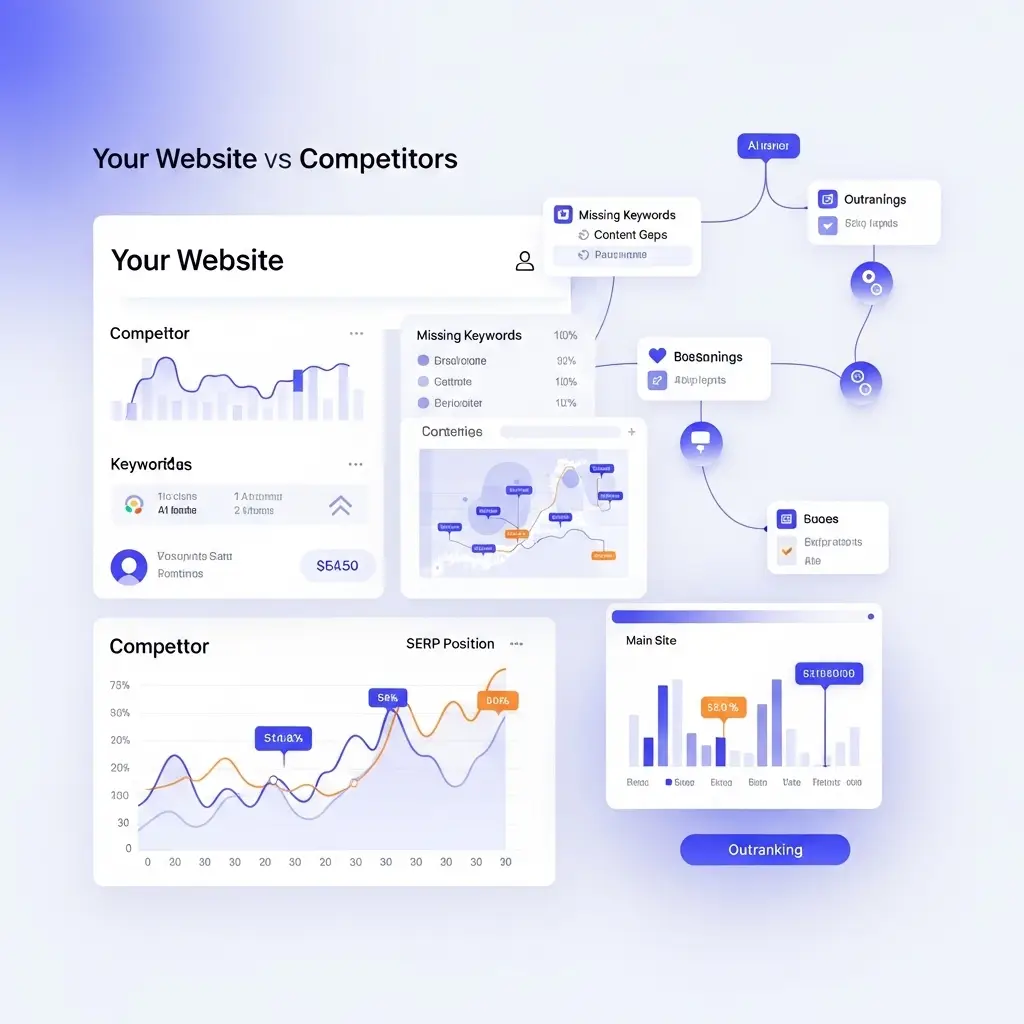
A content gap is an unmet search need that a website can answer credibly. It may be a missing topic, a weak existing page, the wrong format or a page aimed at the wrong audience. Finding competitors’ keywords is only the beginning. The useful outcome is a prioritized decision to create, update, merge, reject or monitor a URL. Google’s people-first content guidance provides a useful quality check before a gap becomes a publishing assignment.
In iGaming, the analysis must separate player-facing operators, affiliates and B2B suppliers. Comparing them in one export creates a large list of opportunities that may have no value for the actual business.
Define the audience before choosing competitors
Write a one-sentence scope that names the business model, target audience, language and market. Then choose search competitors whose pages repeatedly appear for that same audience. A football news site may rank for match terms, but it is not a useful content benchmark for a company selling match signal sources to operators.
Use separate competitor sets for:
- player information and operator content;
- affiliate and comparison content;
- operator procurement and agency evaluation;
- supplier, integration and implementation research.
This separation also prevents a B2B site from filling its calendar with high-volume consumer topics that cannot produce qualified enquiries.
Record five types of gap
Missing-topic gap
The site has no page for a relevant task that competitors answer well.
Weak-page gap
A page exists, but it lacks the detail, evidence, format or clarity required to satisfy the query.
Intent gap
The site targets the words but provides the wrong page type. A sales page may appear where searchers expect a technical guide, for example.
Format gap
The topic is covered, but readers need a comparison table, template, checklist, calculator, video or another useful format.
Trust gap
The page lacks sources, ownership, dates, product facts or compliance context needed for a confident decision.
Choose real search competitors
Start with domains that rank for several high-priority queries, not only brands considered commercial rivals. Validate each candidate manually. Record the audience and result type of its ranking pages. Exclude forums, news sites or consumer operators when they do not answer the same business need.
Use one to three close competitors for a focused first pass. A larger set can be useful later, but it often produces noise before the scope is stable.
Run the analysis with or without a paid tool
Ahrefs workflow
Enter the site and selected competitors in Content Gap. Filter out competitor brands and irrelevant topics. Look for queries where more than one competitor ranks strongly. Export the result and add the business fields in the worksheet below before approving any page.
Search Console and manual workflow
Export the site’s pages and queries. Group current demand by audience and intent. Search the priority queries and record the pages that repeatedly appear. Compare their coverage and format with the current ranking URL. This method takes longer but forces the team to review the actual result rather than accepting every tool suggestion.
Copyable content gap worksheet
| Field | What to enter |
|---|---|
| Topic or query | The demand being evaluated |
| Audience | Player, operator, affiliate or supplier |
| Intent | Informational, commercial, transactional or navigational |
| Market and language | The intended context |
| Competitor URLs | Pages that satisfy the same task |
| Current URL | The site page already associated with the topic |
| Gap type | Missing, weak, intent, format or trust |
| Evidence | Positions, impressions, customer questions or source data |
| Business fit | Relationship to a verified product or service |
| Original contribution | Template, first-party process, data or verified explanation |
| Risk | Legal, product, rights or factual uncertainty |
| Effort | Research, writing, design and technical work |
| Action | Create, update, merge, reject or monitor |
| Owner and due date | Person accountable for completion |
Prioritize with a transparent score
Score opportunity, business fit, evidence strength, ability to add original value and ranking feasibility from one to five. Score effort from one to five and subtract it. Keep compliance risk as a separate gate so a high total cannot approve an unsafe or unverifiable page.
A useful formula is:
Priority = opportunity + business fit + evidence + original value + feasibility – effort.
Interpret the total as a sorting aid. Review the high-scoring rows manually, confirm they have distinct URL ownership and then move them into the topic cluster map.
Worked operator example
Suppose competitors rank for “SEO for iGaming sites” with implementation guides, while the site has only a commercial service page. That is an intent and format gap. The correct action is a practical roadmap covering crawlability, architecture, content, localization, authority and measurement. The commercial page can remain the service destination.
Worked B2B supplier example
Suppose consumer sites rank for “football live stream,” but the company sells match signals to operators. Creating another consumer viewing page would not close a useful business gap. The better research set includes “football match signal source,” “streaming API integration” and “sports streaming website supplier.” Each candidate still needs a SERP check because similar words can mask different audiences.
Choose update, create, merge or reject
- Update when an existing URL already owns the intent but needs better coverage.
- Create when the audience and task are distinct and no current page can satisfy them.
- Merge when two pages compete for the same intent and one can absorb the useful material.
- Reject when the topic is outside the business, market or available expertise.
- Monitor when evidence is too limited for a durable decision.
When merging, preserve a useful source URL with a one-hop redirect to a closely relevant page. Replace internal links and remove the old URL from discovery surfaces.
Measure whether the gap was closed
Record the publication or update date. Review Search Console at page and query level, then compare qualified enquiries or another first-party outcome. A ranking increase for unrelated player queries does not prove that a B2B gap was closed.
Repeat the analysis when the product, target market or competitive result set changes. Do not run it merely to create a fixed number of monthly articles.
Questions about content gap analysis
How many competitors should be compared?
Begin with one to three domains that repeatedly rank for the same audience and intent. Add more only when they provide a distinct, relevant benchmark.
Should low-volume gaps be ignored?
No. A narrow B2B query may have limited reported volume but strong commercial fit. Use customer and Search Console evidence alongside tool estimates.
How often should the analysis be repeated?
Repeat it after meaningful changes in products, markets, search demand or competitors. Maintain the worksheet continuously instead of restarting from an empty export.
Apply this planning work to the appropriate operator context: online casino marketing services or sportsbook marketing services. For the full search service scope, see our iGaming SEO services.