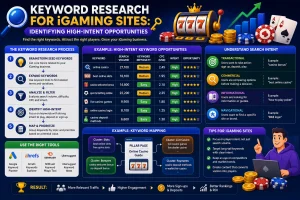

A sports betting SEO project needs an agreed starting point: the audiences the website serves, the pages that matter and the evidence used to measure progress. Without that foundation, an operator can receive a long list of keywords and technical issues without knowing what should happen first.
Use this checklist to turn a general request for more organic traffic into a workable project. It is designed for operators planning SEO work, whether implementation will be handled internally, by a supplier or by both teams.
Define markets, audiences and measurable goals
Start with the business scope. Record the markets and languages your team has approved, the products currently available and any restrictions on what the website can offer. SEO planning should follow those decisions rather than determine them.
Then identify the audience for each part of the site. An operator’s customer-facing pages usually answer different questions from a supplier’s B2B service pages. Someone researching a sports betting topic is not necessarily looking to buy a match signal service or hire an SEO company.
Choose a small set of outcomes that match the project. These could include better visibility for relevant non-brand searches, more organic visits to important pages or more qualified enquiries where the site has a B2B purpose. For customer-facing businesses, define the appropriate conversion events with the analytics team.
Write the goal in a form that can be reviewed: the audience, page group, measurement and reporting period. Avoid using a general increase in total traffic as the only success criterion.
Establish the technical starting point
Before commissioning new articles, find out whether existing important pages can be discovered and understood. An inaccessible page needs a different response from a page that is indexed but does not answer the intended search query.
Collect crawl and indexing evidence
Ask for a list of the main page types and the URLs selected for inspection. Include product pages, useful guides, category pages and relevant language versions. Record the problem found, the evidence and its likely scope.
Distinguish a problem affecting one old article from an issue in a template used across the site. If a template creates an incorrect directive on every service page, correcting individual pages will not provide a durable solution.
Google’s Search Essentials sets out the basic requirements and policies for appearing in Search. Meeting those requirements supports eligibility; it does not guarantee that a page will be indexed or ranked for a particular query.
Review URL relationships and mobile content
The initial review should also identify which URLs are intended to represent the same content, which pages are genuinely translated alternatives and whether important information is available in the mobile experience.
Ask the team to document intended behavior before changing canonicals, redirects or language settings. A site can contain similar pages for valid reasons. Similar wording alone is not enough to justify removing a page.
Use the technical SEO checklist to organize these checks and record completion evidence.
Assign a purpose to every important page
A useful content plan connects an audience question to one suitable page. The plan should show what the visitor needs to learn or do, how the page will answer that need and where it sits within the site.
The following examples are illustrative planning tasks, not keyword-volume research or recommended gambling offers:
| Page role | Visitor’s task | Content requirement | Useful review evidence |
|---|---|---|---|
| Product information | Understand an available service | Accurate scope, limitations and next step | Relevant enquiries and search queries |
| Educational guide | Understand a specific concept | Clear explanation and worked example | Relevant non-brand searches and useful onward visits |
| Support information | Resolve a practical question | Current instructions and accessible contact route | Successful task completion where measurable |
| Language version | Read equivalent information in a preferred language | Complete, reviewed localization | Correct language shown and audience-relevant visits |
Before adding a page, check the existing library. If another article already answers the same question well, improving it may be more useful than creating a second version with a slightly different title.
For every proposed article, write down its distinct contribution. That might be a comparison table, an implementation checklist or an explanation supported by verified product information. A list of related phrases is not yet an editorial brief.
Keep player-facing research separate from supplier research. Mixing the two can produce a plan that attracts visitors who have little reason to use the business being promoted.
Agree an ordered delivery plan
The proposal should turn findings into a sequence of work, not simply assign every issue the same urgency. Prioritize problems that prevent important pages from functioning or being discovered, then address accuracy, page purpose and supporting improvements.
For each item, record:
- The affected URLs or template.
- The specific change and the reason for it.
- The person or team responsible for implementation.
- Dependencies, access requirements and approval steps.
- The evidence needed to confirm completion.
- The date of implementation for later reporting.
For example, “improve internal links” is too broad to verify. A stronger task names the relevant source pages, intended destinations and the check that confirms visitors can follow the links on the live site.
Separate delivery dates from expected search outcomes. A team can commit to completing and verifying an agreed edit by a date. That commitment does not establish when Google will revisit the page or how rankings will respond.
Maintain a short change log. It becomes difficult to interpret performance when titles, content, navigation and tracking all change without a record.
Keep match streaming requirements separate in the brief
An operator may also need match signal sources or a dedicated streaming website. Record that as a separate requirement, with its own specification and acceptance checks.
CD Marketing offers football and cricket match signal sources through API delivery or a separate website project. The core API option includes signals and a basic league, team, date and time schedule. Livescores and additional fixtures or data are optional paid extras.
Confirm the required coverage, delivery format, delay, support and commercial terms during consultation. A streaming implementation should not be presented as a guarantee of improved organic rankings or customer acquisition.
This separation lets the SEO team measure search work while the technical team tests the streaming requirement against its agreed specification.
Measure useful organic outcomes
Build reporting around the original goals and baseline. Search Console provides clicks, impressions, click-through rate and average position, with views by query, page, country and device. These help explain search visibility, but they do not measure customer value by themselves. Google’s Performance report documentation.
For project reviews, combine a clear delivery log with relevant search evidence and any agreed business outcomes. Compare like-for-like page groups and periods. Note major events, new content, tracking changes or product changes that may affect interpretation.
Ask three questions: Did the planned work go live correctly? Is the site reaching more of the intended search audience? Are those visits supporting the business goal where measurement is available?
Do not treat every movement as proof of the latest edit. Small volumes and changing demand can make short comparisons unreliable. Record uncertainty alongside the result.
Questions to resolve before work begins
Agree who owns the website and analytics access, who approves content and who can implement technical changes. Confirm how the supplier will handle work that falls outside the original scope.
The SEO and streaming project-brief guide can help organize these requirements. To discuss an SEO project with CD Marketing, start with the Google SEO service overview.
What access is needed for an SEO audit?
Start by defining the audit scope. Website inspection and existing Search Console information may support the initial review; editing access is a separate requirement. Agree the appropriate permissions for each task rather than sharing unrelated accounts or credentials.
How should a sports betting SEO project be measured?
Use the agreed page and audience goals, supported by a record of completed work. Relevant search visibility and clicks provide context; properly defined conversions add business evidence when available. No single score can replace that combination.
For implementation options, see our sportsbook marketing services, including Google SEO and match signal delivery. This checklist helps prepare the brief; the service page explains the available commercial scope.