An effective landing page must answer those needs quickly and clearly. It should show that your agency understands the commercial realities of online casinos, sportsbooks, poker platforms, and gaming operators while also demonstrating experience with regulated markets, responsible gambling, and performance-driven acquisition.
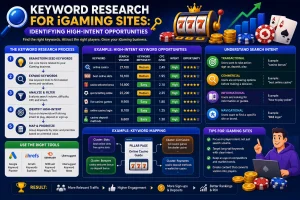
What Search Intent Means in iGaming
Search intent describes the reason behind a query. In iGaming marketing, intent generally falls into four categories.
Informational searches seek knowledge. Examples include “how iGaming SEO works,” “casino marketing regulations,” and “how to improve sportsbook conversions.” These searches are ideal for educational content that builds authority and introduces your brand to potential clients.
Navigational searches involve users looking for a specific company, service, or resource. Someone searching for an “iGaming digital marketing agency” may already know what type of provider they need and could be evaluating several brands.
Commercial investigation searches indicate that the user is comparing options. Queries such as “best iGaming marketing services,” “iGaming growth agency,” or “casino SEO agency pricing” suggest that the visitor is closer to making contact.
Transactional searches show a stronger desire to act. A business searching for “iGaming marketing agency consultation” or “iGaming lead generation services” may be ready to submit a form, book a call, or request a proposal.
A landing page performs best when its message matches the visitor’s stage. An educational search should not be met with an aggressive sales pitch, while a high-intent commercial query should not lead to vague, general information.
Aligning Landing Pages With the Right Intent
The first step is mapping one primary search intent to each landing page. A page targeting “iGaming digital marketing services” should explain the services available, the problems they solve, and the outcomes clients can reasonably expect. It should not attempt to rank for every possible casino-related keyword.
A page focused on “iGaming marketing agency” can target broader commercial intent. It may present the agency’s strategic approach, areas of expertise, markets served, and campaign capabilities. More specific pages can then target individual services such as technical SEO, paid search, affiliate marketing, content production, conversion optimization, and CRM automation.
This structure creates a logical journey for both users and search engines. Visitors find a page that reflects their needs, while Google can better understand the relationship between the website’s service pages, educational resources, and brand information.
Building a Strong iGaming Marketing Landing Page
The headline should confirm relevance immediately. A clear headline might state:
Performance-Led iGaming Marketing for Regulated Growth
The supporting text should explain who the service is for and what it delivers. For example, it may mention casino operators, sportsbook brands, platform providers, and companies entering new regulated markets.
Avoid broad claims such as “the world’s number one agency” unless they can be substantiated. Trust is especially important in iGaming because the sector is subject to advertising restrictions, licensing requirements, age limitations, and responsible gambling obligations.
A strong landing page typically includes:
- A concise value proposition
- Clearly defined iGaming marketing services
- Relevant market and channel expertise
- Evidence of experience or results
- Information about compliance and responsible marketing
- A transparent call to action
- Trust signals such as certifications, partnerships, reviews, and company details
The page should guide users toward one primary action, such as requesting an audit or booking a strategy call. Additional links can support research, but too many competing calls to action can reduce conversions.
Using Keywords Naturally and Strategically
Primary keywords should appear in important areas, including the title tag, H1 heading, introductory copy, URL, meta description, and relevant subheadings. However, repeating the same phrase unnaturally can damage readability and weaken trust.
Use related terminology to create topical depth. For an iGaming agency page, relevant entities may include online casinos, sportsbooks, poker rooms, gaming operators, affiliates, payment providers, licensing jurisdictions, customer lifetime value, player acquisition, retention, SEO, paid media, analytics, and conversion rate optimization.
Keyword variations such as “iGaming digital agency,” “iGaming digital marketing agency,” and “iGaming marketing services” can be incorporated where they genuinely fit. Each variation should support the page’s meaning rather than appear as a forced addition.
Search engines increasingly evaluate context, expertise, and usefulness. A page that discusses acquisition without mentioning retention, compliance, data privacy, or player quality may appear incomplete to both users and search algorithms.
Demonstrating E-E-A-T in a Regulated Industry
Experience, expertise, authoritativeness, and trustworthiness are essential for iGaming websites. Landing pages should make it easy for potential clients to understand who is behind the service and why the agency is qualified to advise gaming businesses.
Include specific details about relevant experience, such as work across regulated markets, experience with sportsbook launches, knowledge of casino affiliate ecosystems, or expertise in multilingual SEO. Where possible, support claims with verifiable case studies, documented processes, client testimonials, and measurable outcomes.
Avoid publishing unsupported performance promises. Claims about revenue growth, rankings, player volumes, or acquisition costs should be accurate, appropriately qualified, and based on real evidence.
Trust can also be strengthened through visible company information. Include a physical business address, contact details, privacy policy, terms of service, and information about the team. A clear explanation of how data is collected and used is particularly important when forms request business or personal information.
Making Compliance Part of the Value Proposition
Compliance should not be hidden in a footer. It can be a meaningful differentiator for an iGaming growth agency.
Landing page content should acknowledge that advertising rules differ by jurisdiction. Search campaigns, social advertising, influencer promotions, affiliate relationships, and email marketing may all be subject to specific restrictions. Operators may also need to consider age-gating, identity verification, advertising disclosures, self-exclusion requirements, and responsible gambling messaging.
A credible iGaming digital marketing agency can explain how campaigns are planned with market suitability in mind. This includes reviewing licensing status, targeting only permitted audiences, avoiding misleading promotions, and ensuring that creative assets do not appeal to minors or encourage harmful gambling behavior.
Responsible gambling language should be clear and proportionate. Marketing should never present gambling as a guaranteed income source, a solution to financial problems, or a risk-free activity.
Improving Conversion Rate Without Sacrificing Trust
Conversion optimization begins with reducing uncertainty. Prospective clients want to know whether the agency understands their market, can work with their technology stack, and has a process for measuring success.
Use concise service descriptions that connect activities to business objectives. Instead of simply stating “technical SEO,” explain that the service may address crawlability, page performance, international structures, indexation, and organic visibility. Instead of “paid media management,” discuss market targeting, creative testing, budget controls, tracking, and qualified acquisition.
Forms should request only the information needed for the next step. A short form asking for a name, business email, company, market, and primary challenge often performs better than a lengthy questionnaire. The surrounding copy should explain what happens after submission and when the prospect can expect a response.
Visual hierarchy matters too. Important information should appear above the fold, while detailed proof, methodology, frequently asked questions, and supporting resources can appear further down the page.
Measuring Landing Page Performance
SEO traffic is only valuable when it supports meaningful business outcomes. Monitor rankings, impressions, click-through rates, engagement, form submissions, booked meetings, qualified leads, and customer acquisition metrics.
Segment performance by market, device, channel, and search intent. A page may attract substantial traffic from informational searches but generate more valuable leads from a smaller commercial audience. This distinction prevents teams from optimizing for visits alone.
Use analytics platforms and conversion tracking responsibly, with appropriate consent and privacy controls. Review search query data regularly to identify mismatches between the page and the audience’s expectations. If visitors leave quickly, the content may be too general, the message may lack credibility, or the page may not satisfy the query.
The most effective iGaming marketing services combine technical precision with a clear understanding of human decision-making. When a landing page matches search intent, communicates expertise, addresses compliance, and offers a straightforward next step, it becomes more than an SEO asset. It becomes a trusted bridge between a gaming business and the growth support it needs.
Apply the plan to your operator website
CD Marketing focuses on iGaming SEO services and sports live streaming signal sources. For a service brief suited to your business, explore our online casino marketing services or sportsbook marketing services, then discuss your project with CD Marketing.