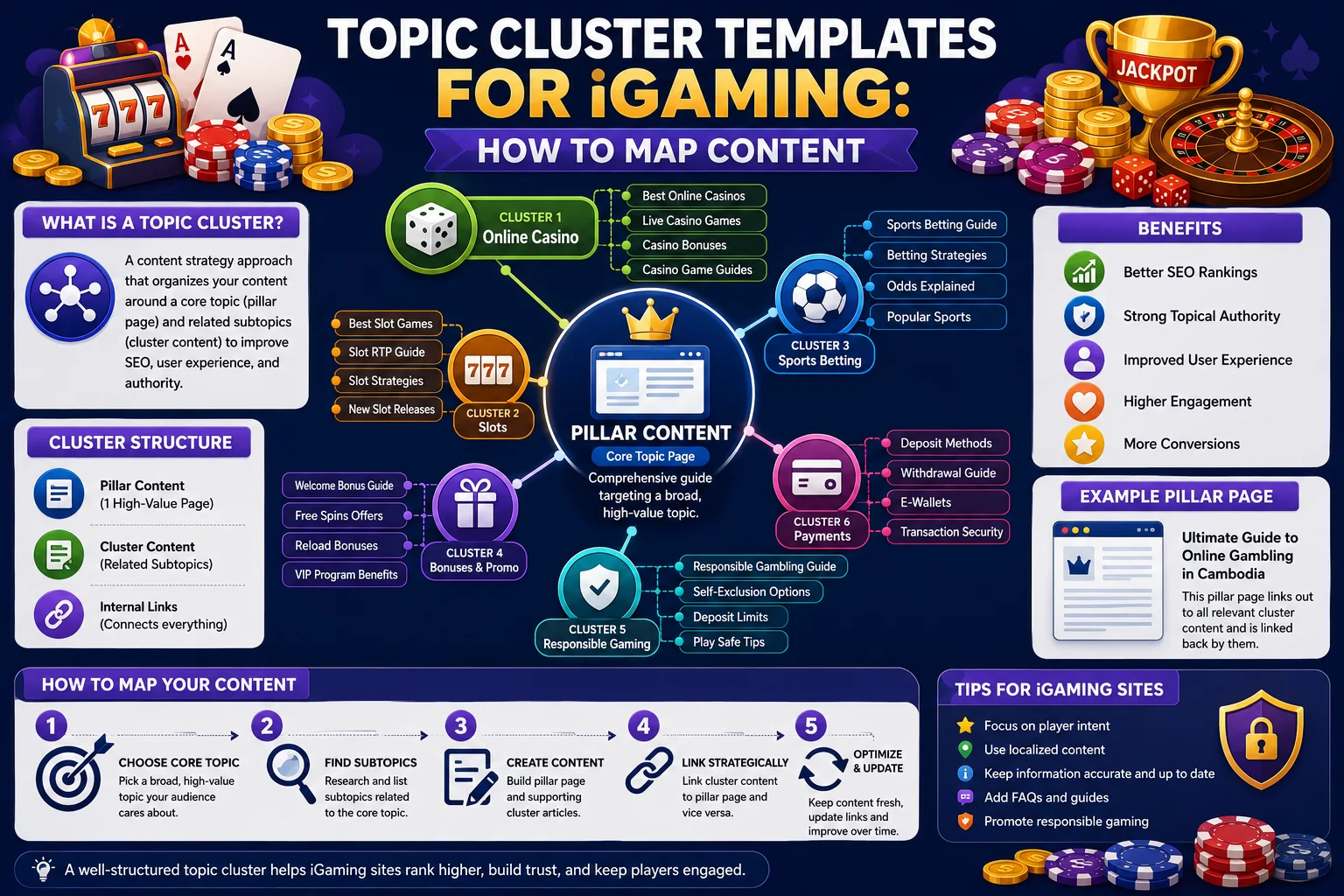
A useful topic cluster is a publishing system, not a list of related keywords. It assigns every important search need to one page, shows how supporting pages connect to that page and gives the editorial team a clear rule for creating, updating or merging content.
That discipline matters in iGaming because one website may address players, operators, affiliates and technology suppliers. If those audiences are mixed into the same cluster, several pages can compete for the same query while none fully answers it. The template below helps an operator or supplier build clusters around a defined audience, market and business goal.
What an iGaming topic map must decide
Each planned URL needs an owner and a purpose. Before collecting keywords, record the site’s business model, intended markets, languages, permitted topics and conversion paths. An operator page that helps a player compare games has a different job from a B2B page that helps an operator evaluate a match signal source.
A complete map answers six questions. This approach follows Google’s emphasis on helpful, reliable, people-first content and gives editors a documented reason for every URL:
- Who is the page for?
- What decision or task should it help with?
- Which search intent does it own?
- Which page is the cluster’s main hub?
- Which supporting pages should link to it?
- Who verifies product, regulatory and market claims before publication?
Use one row per intended URL. Do not create a new row simply because a keyword tool shows another phrase. If two phrases produce substantially similar results and require the same answer, they normally belong to one page.
Separate player, operator and supplier intent
Audience separation is the first defence against cannibalization. A player may search for a match schedule or a game guide. An operator may search for an SEO agency, a streaming website supplier or a sports match signal source. A supplier may research integrations, delivery formats or commercial partnerships.
Label every candidate as player informational, player transactional, operator commercial, operator informational or supplier research. Then compare the pages currently ranking for the query. If the results are dominated by consumer websites, a B2B service page is unlikely to satisfy that intent even when the words appear relevant.
Copyable topic cluster template
| Field | What to record | Decision it supports |
|---|---|---|
| Cluster | The broad subject, such as operator SEO | Groups related work |
| Pillar URL | The main page that owns the broad intent | Prevents competing hubs |
| Page topic | The precise question or task | Defines useful scope |
| Audience | Player, operator, affiliate or supplier | Separates incompatible intent |
| Market and language | Intended region and visible page language | Guides localization and review |
| Search intent | Informational, commercial, transactional or navigational | Determines format and call to action |
| Primary query | The main demand the URL will own | Supports title and content decisions |
| Evidence | Search Console, SERP, sales question or research source | Explains why the page should exist |
| Internal links in | Pages that should reference this URL | Improves discovery and context |
| Internal links out | Next useful pages for the reader | Builds a coherent journey |
| Compliance owner | Person responsible for checking sensitive claims | Reduces publishing risk |
| Action and status | Create, update, merge, reject or monitor | Keeps the map operational |
| Review date | Next evidence and accuracy check | Prevents unmanaged decay |
Worked cluster for operator Google SEO
The pillar should explain the complete service or implementation roadmap. Supporting pages should each solve a narrower problem that deserves its own result.
| Page role | Distinct task | Natural next link |
|---|---|---|
| Pillar | Explain the operator SEO roadmap | Technical, content and measurement guides |
| Technical support | Audit crawling, indexation, canonicals and performance | Roadmap and multilingual setup |
| Keyword support | Separate player demand from B2B demand | Topic map and content gap analysis |
| Content support | Plan pages by intent and market | Keyword research and localization |
| Measurement support | Read page and query performance | Update and merge decisions |
| Commercial page | Explain the agency’s verified SEO service | Consultation and project briefing |
CD Marketing’s iGaming SEO roadmap can own the implementation intent, while the Google SEO service page owns the commercial enquiry. Keeping those purposes separate makes both pages more useful.
Worked cluster for sports match signal sources
The product entity should remain consistent across the cluster. CD Marketing provides football and cricket match signal sources. An API is one delivery format. A dedicated streaming website is the other service model. Basic schedule data can include league names, club names, dates and times, while live scores, fixtures and other data are optional additions confirmed during consultation.
A clear cluster can use the sports match signal and streaming service as the hub, with separate football and cricket pages for sport-specific procurement questions. Supporting articles may explain integration preparation, schedule data, website delivery and project briefing. They should not invent fixed coverage, latency, rights, formats or pricing.
Map internal links without creating competing pages
Every supporting article should link to its pillar where that link helps the reader continue the task. The pillar should link back to the strongest supporting resources. Use anchor text that describes the destination, such as “iGaming keyword research workflow,” rather than repeated exact-match phrases in every paragraph.
Before adding a planned page, compare it with existing URLs. Merge it when the audience, intent and expected answer substantially match an existing page. Create it when the reader needs a separate task, format or decision. Reject it when it is outside the business scope or cannot be supported with reliable facts.
Prioritize the cluster
Score each row from one to five for business fit, evidence of demand, ability to provide original value and implementation effort. Add a compliance-risk field instead of hiding risk inside a total score. A page with strong demand but unverifiable product claims should not move into production until those facts are available.
Start with the pillar and the few supporting pages required to answer the main journey. A smaller complete cluster is more useful than dozens of thin articles. Review Search Console after enough data has accumulated, then update weak pages, merge overlap and expand only where a clear unanswered need appears.
Common topic mapping mistakes
- Creating one page for every keyword variation.
- Mixing player searches with operator procurement searches.
- Using the same article in several language folders without real localization.
- Publishing product details that the commercial or technical team has not confirmed.
- Building clusters around services the company does not provide.
- Leaving old pages live after a stronger replacement has been published.
Questions teams ask about topic clusters
How many supporting pages should a cluster have?
There is no required number. Build the pages needed to answer distinct, evidenced tasks. Stop when another page would repeat an existing intent.
When should two pages be merged?
Merge them when they serve the same audience, answer the same intent and appear for the same group of queries. Preserve the stronger URL and redirect the weaker one when the replacement is genuinely relevant.
Should language versions be combined?
No. Equivalent topics in different languages should keep separate URLs. Connect true equivalents with correct language annotations and make each version useful to its intended readers.
Apply this planning work to the appropriate operator context: online casino marketing services or sportsbook marketing services. For the full search service scope, see our iGaming SEO services.