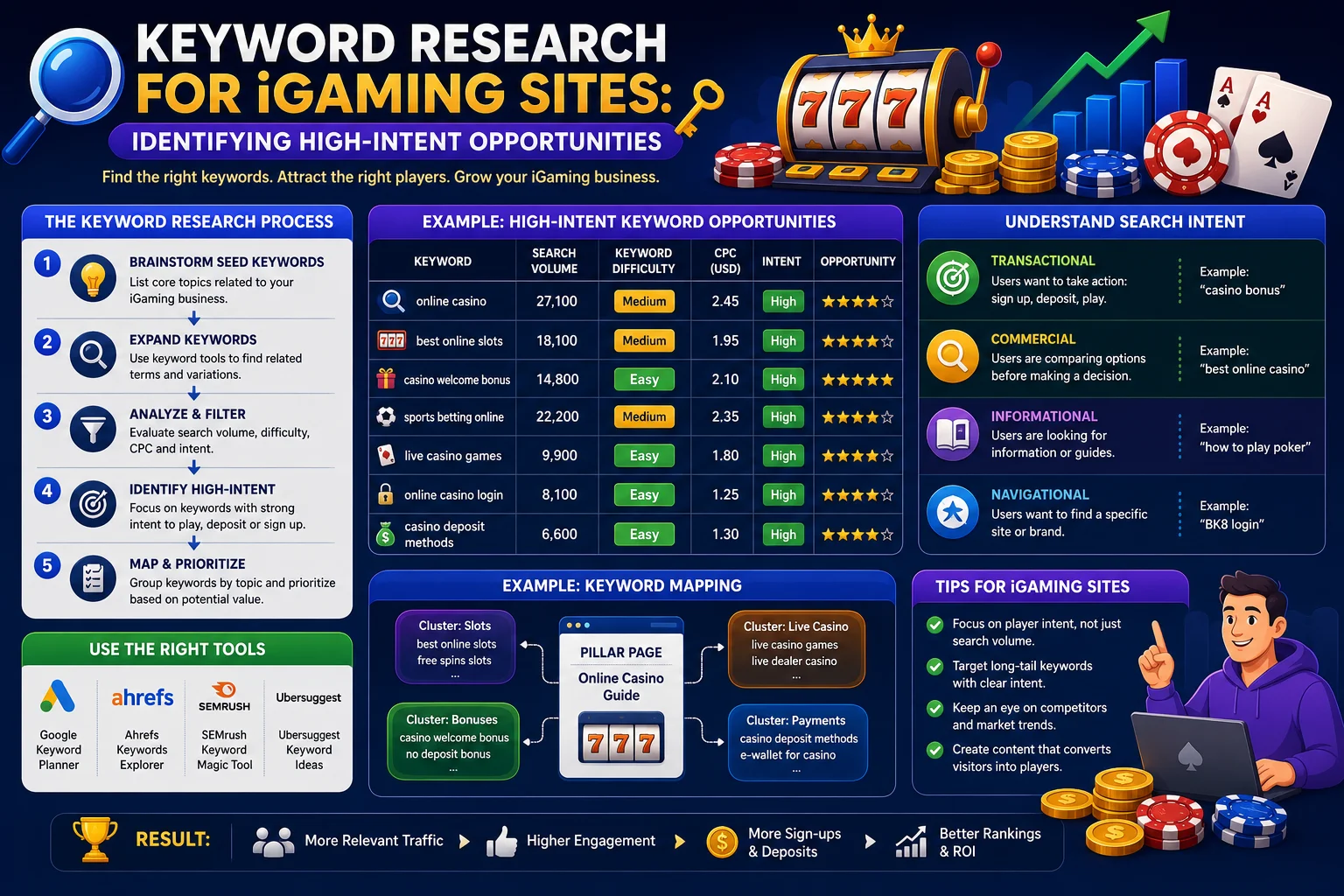
Keyword research for an iGaming website starts with the business model, not a database export. The same phrase can attract players, operators, affiliates or suppliers, and those audiences expect different pages. A useful process identifies the audience behind a query, checks what Google currently rewards and assigns the query to a page that can satisfy the task.
This guide provides a repeatable workflow for operators and B2B suppliers. It avoids treating search volume as the only decision and shows how to reject terms that do not fit the product, market or compliance boundaries.
Define the business model and market first
Record whether the site represents an operator, affiliate, platform, data supplier, agency or another B2B service. Then record the intended markets and languages. A Simplified Chinese page, for example, is a language version and does not automatically target China. Country targeting requires its own market evidence and compliance review.
For CD Marketing, the two main offers are Google SEO for iGaming operators and sports match signal sources delivered through an API or a dedicated streaming website. That definition excludes keyword groups for paid advertising management, social media management or affiliate programme management.
Separate four intent groups
Player informational intent
These searches ask how a game, event, payment method or betting concept works. They normally require a clear guide, glossary, comparison or support resource. They do not belong on a B2B agency page.
Player transactional intent
These searches indicate that a user wants to register, play, claim an offer or find an operator. They require jurisdiction-specific operator content and careful compliance review.
Operator commercial intent
These searches come from businesses comparing an agency, supplier or service. Examples include “iGaming SEO agency,” “football match signal source” and “sports streaming website provider.” The page should explain scope, evaluation criteria, implementation questions and the next commercial step.
Supplier and integration research
These searches concern delivery, data fields, technical ownership and project preparation. The best result may be an implementation guide rather than a sales page. For match signals, keep the product and delivery format separate: the signal source is the product, while an API is one method of delivery.
Build seed lists from products, problems and workflows
Start with verified nouns and tasks. Product seeds describe what is sold. Problem seeds describe what the buyer needs to solve. Workflow seeds describe how the buyer evaluates or implements the solution.
| Seed type | SEO example | Match-signal example |
|---|---|---|
| Product | iGaming Google SEO service | football match signal source |
| Problem | pages not indexed | add live matches to an operator site |
| Workflow | SEO audit checklist | streaming API integration questions |
| Comparison | SEO agency evaluation | API versus dedicated streaming website |
| Measurement | Search Console page analysis | schedule and delivery acceptance checks |
Expand the list with Search Console queries, customer questions, internal sales language and an SEO database. Remove phrases that depend on a service the company does not provide or a market it does not serve.
Validate the search results before choosing a page
Search the query from the intended market and study the dominant result type. Record whether the leading results are service pages, guides, tools, lists, news or consumer operator pages. Review several close variants because a single word can change the audience. Use the Search Console performance report to validate the queries and pages already associated with the site.
Also check the terms and entities that recur across credible results. These help define topical coverage, but they do not justify copying competitors. The page still needs original utility such as a decision table, verified product facts, a template or a worked process.
Use a keyword decision table
| Field | Purpose |
|---|---|
| Query | The exact search phrase being assessed |
| Audience | Player, operator, affiliate or supplier |
| Intent | Informational, commercial, transactional or navigational |
| Market and language | The location assumptions and visible language |
| Dominant result type | The format searchers currently receive |
| Current ranking URL | The existing page already associated with the demand |
| Business fit | How directly the query relates to a verified offer |
| Evidence | Search Console, SERP, sales or industry research |
| Risk | Legal, product, rights or factual verification needed |
| Action | Create, update, merge, reject or monitor |
Prioritize with a transparent score
Use a one-to-five score for business fit, intent strength, evidence of demand, ability to add original value and ranking feasibility. Score effort separately, then record compliance risk as a visible gate. A simple priority calculation is:
Priority = business fit + intent strength + evidence + original value + feasibility – effort.
Do not allow the number to overrule judgment. A high-volume player query may receive a lower business-fit score for a B2B supplier than a low-volume operator query. A promising term with unverified legal or product assumptions remains blocked until the facts are confirmed.
Map one primary intent to one URL
Use the iGaming topic cluster template to assign the accepted query to an existing or planned URL. Update the current page when it already owns the intent. Merge pages when they answer the same task. Create a new URL only when the audience or required answer is genuinely different.
A page may naturally rank for many related phrases. The rule does not mean using one keyword per page. It means giving each distinct search task one clear owner.
Worked examples
Operator example
An operator researching “SEO for iGaming sites” needs a roadmap covering crawlability, architecture, content, internal links, authority and measurement. The iGaming SEO roadmap can own that task. A commercial query such as “iGaming Google SEO agency” should lead to the service page instead.
B2B match-signal example
“Football match signal source” indicates supplier evaluation. “Football live scores” usually indicates consumer information. Even though both concern matches, they require different pages. CD Marketing should build content around the procurement and implementation need, while confirming coverage, format, delay, support, rights and pricing during consultation.
Questions about iGaming keyword research
Should a B2B team ignore low-volume keywords?
No. SEO tools can understate narrow commercial demand. A low-volume phrase can be valuable when it closely matches a qualified procurement need and the business can provide the best answer.
How often should the map be updated?
Review it after material product changes, market changes or enough Search Console data to support a decision. Avoid changing page ownership merely because of a few days of movement.
Does adding more keyword variations improve rankings?
Not by itself. Use natural variants when they help explain the topic. Repetition without additional value makes the page harder to read and does not solve a missing intent.
Apply this planning work to the appropriate operator context: online casino marketing services or sportsbook marketing services. For the full search service scope, see our iGaming SEO services.